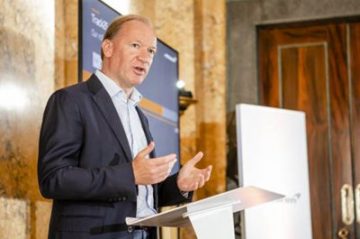
Mike Flewitt.
McLaren Automotive plans to launch 18 new cars in a $2.1 billion 100% hybrid project by 2025.
The British sportscar and supercar maker announced its wide-ranging business plan at the Goodwood Festival of Speed on July 13.
Track25 is an evolution of the Track22 plan that was first launched at the Geneva Motor Show in 2016 and the updated plan includes significant new milestones.
It sets out a clear roadmap for future vehicles, production and technology.
McLaren says it’s committed to ensuring that its sportscar and supercar range will be hybrid within seven years.
The company will also evaluate new augmented driving features and help develop a lighter, superfast-charging, high-power battery system for performance applications that is expected to have over 30 minutes of electric range around a race track.
It also aims to ensure that each of its products is the lightest in their segment.
This complements a $89 million investment in developing and manufacturing the future of light-weighting technology with the soon to-open McLaren Composites Technology Centre (MCTC).
Having launched the world’s first petrol-electric hybrid-hypercar five years ago with the McLaren P1TM, the company plans to unleash its successor as part of the Track25 plan.
Investment in 18 new models or derivatives will help lift production by almost 75% to around 6000 cars annually by the middle of the next decade. All will be hand-assembled at the McLaren Production Centre in Woking, England.
Cars will feature enhanced cyber protection, improved vehicle tracking and over-the-air (OTA) software updates.
“We are set to add more retailers in both existing and exciting new markets as demand for our products continues to grow,” McLaren Automotive chief executive officer Mike Flewitt says.
Retailing in 31 markets around the world through an 86-strong retailer network, McLaren Automotive is looking at expanding in existing markets as well as evaluating several major new markets, including Russia, India and Central/Eastern Europe.