The technology community’s top leaders have made a promise not to develop or trade in lethal autonomous weapons.
Corporate heads, engineering leaders and scientific top brass, including Tesla chief executive Elon Musk, have signed a pledge against supporting any form of market or use of autonomous weapons such as drones, cybernetic life, and land-based vehicles.
The 2018 International Joint Conference on Artificial Intelligence in Stockholm has seen 5000 attendees including the world’s biggest AI research groups sign the pledge, including 500 companies like Google DeepMind, Tesla and Space X’s Elon Musk, ClearPath Robotics (aka OTTO Motors), European Association for AI and the Swedish AI Society, the University College of London, and University of New South Wales’ professor Toby Walsh.

OTTO Motors founder Ryan Gariepy
The pledge, signed by 2700 people from 90 countries including Australia, and New Zealand’s University of Waikato professor of computer science, Bernhard Pfahringer.
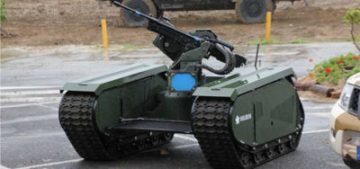
The event is designed to influence governments, industry and academia to safeguard against any form of participation in or support of “the development, manufacture, trade, or use of lethal autonomous weapons”, also dubbed ‘killer robots’, which can identify, target, and kill a person, without a human ‘in-the-loop’.
It effectively means no person has the final decision to authorise lethal force because the choice and accountability about is given to the autonomous weapon. Even today’s drones like the “Predator” is under complete human control, or autonomous systems that do exist are merely defending against other weapons.
Autonomous cars have been scrutinised about their ethical programming when it comes to deciding on the fate of an occupant or a pedestrian/bystander.
OTTO Motors, a company which develops and makes autonomous warehouse vehicles for captive-circuit load transport, and Clearpath Robotics chief technical officer Ryan Gariepy says humans are in trouble if autonomous weapons can be conceived without any early intervention.
“The proliferation of lethal autonomous weapon systems remains a clear and present danger to the citizens of every country in the world,” he warns, “No nation will be safe, no matter how powerful.”
 “Concerns are shared by a wide variety of other key autonomous systems companies and developers, and we hope that governments around the world decide to invest their time and effort into autonomous systems which make their populations healthier, safer, and more productive instead of systems whose sole use is the deployment of lethal force,” Gariepy adds.
Australia’s AI researcher Toby Walsh led an academic boycott of Korea Advanced Institute of Science and Technology (KAIST) in March 2018, which saw more than 50 of the world’s top AI and robotics researchers from 30 countries join the boycott. Less than a week later KAIST agreed to “not conduct any research activities counter to human dignity including autonomous weapons lacking meaningful human control.”
Over 3100 Google employees, including senior engineers, signed a protest letter in April condemning the company’s involvement in a US government Pentagon program called “Project Maven”, using AI to analyze drone imaging.