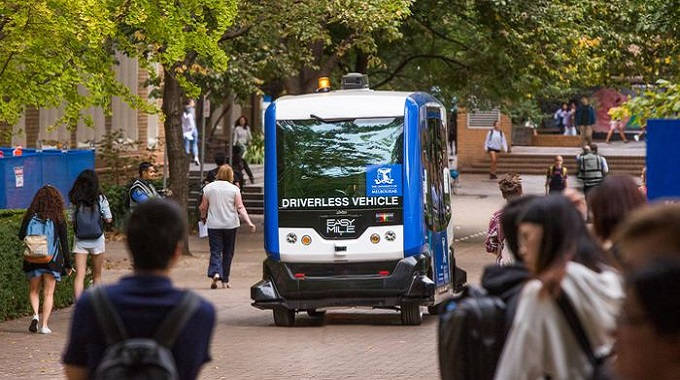
Melbourne University AV trial.
An autonomous vehicle (AV) future in Australia could start with limited use of suitable road sections.
AV shuttle trials are already operating in some areas, usually within set precincts, but a Parliamentary committee investigating the future of automated transport in Australia has heard human involvement in the transport network should be removed to help stop congestion and other traffic issues.
Siemens Mobility business development and strategy head Charles Page told the committee technology must “remove the immediate involvement of humans” throughout the transport network, news.com.au reports.
He says human variability and mistakes are delaying reaching the maximum possible capacity.
Page suggests people should swap cars for autonomous public transport, using self-driving pod-like vehicles to travel to and from train stations, for instance.
But representatives from the Department of Infrastructure and Regional Development and Cities and the Australasian New Car Assessment Program (ANCAP) doubt many people will use driverless pods for commuting within the next decade.
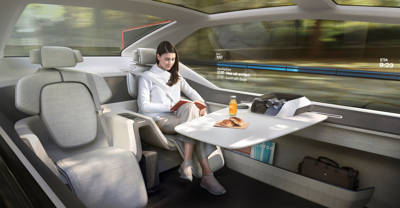
The Volvo 360c illustrates future AV travel.
Committee chairman John Alexander suggests the private car will eventually no longer be used for commuting though.
“Just as the horse was made redundant and became a recreational vehicle, a private car will become a recreational vehicle, because everything else will be taken care of this way.”
Alexander says the committee has seen first-hand the possibilities for the automation of public transport and the use of hydrogen fuel cells to power vehicles.
“The potential for cleaner, greener, more efficient transport systems is immense.”
Hydrogen Mobility Australia notes that automation, connectivity and electric drivetrains are “inextricably linked in that they are complementary technologies”.
The Federal Chamber of Automotive Industries (FCAI) adds that hydrogen fuel cell development is happening globally for a range of vehicle types including buses, trains, heavy trucks and material handling vehicles.
The Australasian Railway Association notes that greater use of automation will assist passenger and freight rail operators to increase their capacity.
Department of Infrastructure co-ordination and research executive director Gayle Milnes believes a fully driverless future is some way off, with major engineering and transport planning challenges to overcome.
That’s echoed by colleague Roland Pittar, the department’s office of future transport technology general manager.
Pittar says any driverless future will begin with “conditional automation” in limited circumstances, with drivers needed in more complex traffic environments.
ANCAP chief executive James Goodwin believes AVs will start on “a highway where everyone is going in the same direction and generally the same speed”.
Consumer confidence and appropriate technical infrastructure are crucial to AVs’ successful introduction, he says.
Goodwin says AVs will function best in areas apart from general traffic, and that AV development is closely linked to the introduction of electric and hydrogen-powered vehicles.
The inquiry has its next hearing on February 27.