
This story first appeared in the july issue of autotalkau – CLICK HERE to download the magazine FREE
 Nissan Australia has confirmed its entire national dealer network is expected to become part of the brand’s Zero Emission sales and servicing strategy, including its rural showrooms.
Speaking to EVTalk this week at the 40kWh Leaf electric car launch in Melbourne, managing director Stephen Lester says every franchised Nissan dealership will be capable of selling, servicing and providing charging support for the new generation Leaf.
Lester says that of Nissan’s 187 franchised dealerships, 60 are already technically prepared in service departments, with trained sales staff and charging infrastructure already in place.
“The 89 dealers already signed up to the Leaf programme roughly represent all our metro and provincial dealers across Australia, the balance is what we would classify as more ‘rural’ dealers,” he says.
“Those dealers are typified by much smaller markets and are relatively remote,” Lester explains.
He says Nissan dealers are vital to supporting the Leaf’s widespread uptake.
“We need them to have the installations because going down the track we cannot deliver an experience where our customer is sacrificing when they go into a dealership,” he explains.
“We have been very clear with the network, the requirements are – we are not going to deliver a sub-standard customer experience with the Leaf,” he confirms.
“We would say to metro or provincial dealer you are going to be a Leaf dealer because with this opt-in-opt-out idea, we’re so convinced of the trajectory for EVs that as a brand we can’t afford to have one dealer saying they’re not doing it and giving a dissatisfaction to the customer,” he reveals.
“The plan will be to on-board rural dealers as we go, those who want to start early can do so and we’ll give them all the benefits.”
Lester says the market in Australia’s more remote regions will actually be a long-term target customer for the benefits of the $50,000 electric car.
“In our expansion plans we’ve gone out to all those rural dealers and said you’re welcome to be a hand-raiser and we’ll provide cars, but we still need you to do the basics, to send your people for training, and we need technical training,” he continues.
“Tools, the EV service campaigns, and charging stations to ensure owners can receive the same level as service as a metro dealer.”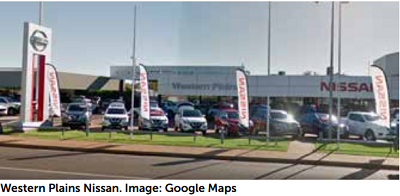
Lester says Nissan hasn’t encouraged the rural network as being part of a “push strategy” and says it was actually on a more voluntary basis.
“They have raised hands and come to us which is why we’ve being saying we’ll see about 89, maybe 90 by the time we go onsale, with charger installs within August, and many who are a bit further down the track,” he says.
Nissan says regional dealers in interesting locations such as tourism destinations, larger populated provincial cities and towns are seeing the strong benefits of having electric vehicle preparations in place.
Customers in rural areas, Lester explains, have “predictable traffic patterns” which are also buoyed by living with renewable energy access such as in-home solar.
“There route is usually pretty specific and being beholden to a petrol station is no longer necessary.
“You need a vehicle to go into town, do grocery shopping, take kids to school – all tasks the Leaf can easily complete. ”
Citing Morgan Stanley Research, Nissan global director of EVs Nic Thomas says the amount of carbon dioxide and oxides of nitrogen produced from compliance of internal combustion drivetrain development will also rise.
The drivetrain costs of CO2 and NOx compliance for electric vehicles versus internal combustion keeps rising, with a crossover period, accounting for real-world driving emissions (RDE), expected around 2024.
Where current compliance costs sit at around $250 per kWh for an EV, it’s expected to drop below $100 per kWh by 2025, in the same two-year bracket when internal combustion is predicted to go from $175/kWh to $225/kWh.
“The costs of those conventional engines will go up,” Thomas says.
“These are the costs to us as a company of building traditional [internal combustion] engines in the way we always have,” he concedes.
“There will be a crossover very soon where a battery car will cost less than a petrol or diesel car,” Thomas highlights.
A bidirectional charging capability allows it to power a home, known as vehicle-to-home (V2H), which means that, in future, Nissan Leaf customers in Australia will be able to use the vehicle to share energy stored in its battery with their home, business or even community.
Plugging into a Chademo rapid charger gets from alert to 80% charge in around an hour.
A collaboration with Jet Charge will assist customers with home charging infrastructure needs.

