 GreenSync is a Melbourne-based global energy-teach company that is connecting millions of distributed energy resources (DERs) and turning electricity grids into market places.
“Every smart device connecting to grids today – especially EVs – needs to be controlled when they download/upload from the network,” GreenSync founder Phil Blythe explains.
“Twenty-five per cent of our infrastructure is used less than 40 hours a year and if we do not harness this down-time we will be adding billions of dollars to consumer costs.
“For instance, expansion of the 1.9 million electric car fleet in Norway is going to drive up the need to upgrade the power grid.
“Without smarter charging, costs are estimated at 11 billion krona (A$1.8b, NZ$1.9b) by 2040 – or A$1000 per vehicle,” Blythe told the EV Transition Conference in Sydney last month.
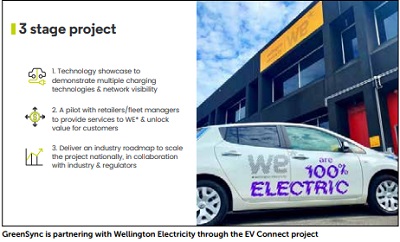
He says that these costs are being avoided in New Zealand (“you know the people that beat us in rugby, netball and cricket – and developed the pavlova”) via EV Connect, a project in partnership with Wellington Electricity.
“We can’t let them beat us in EV acceptance and smart charging too,” Blythe quips.

Phil Blythe
He says that the Wellington project is in three stages:
Introduce a technology showcase to demonstrate multiple charging methods and introduce EVs to the marketplace.
Provide a pilot with retailers and fleet managers to provide services to Wellington Electric and begin unlocking value for customers.
Deliver on an industry road map to scale the project nationally, in collaboration with the industry and regulators.
Blythe says the technology showcase should be delivered by a digital platform – a scalable technology-neutral exchange.
“There should be open access integration, with multiple vehicle charging technologies and operators.
“Wellington Electricity should have visibility over all EV chargers connected to the network, with dynamic limits over vehicle charge rates.”
Blythe says that the pilot should be kept simple with multiple suppliers of charging facilities – definitely no customer lock-ins.
“Customers should be given new value through retail offers in return for charge flexibility.
“They should have choice, with multiple tech charger integrations, both residential and commercial.
“The aim should be to provide network services to Wellington Electric via dynamic connection agreements (DCAs).
Blythe says the smart charging business model should have four parts:
Strong collaboration with industry – early conceptual buy-in from government, regulators, technology vendors and grid operators.
The business case should be network-wide and long term – incremental roll-out will be significantly more expensive and lead to high inequities.
Plan for scale at a state or national level – systems, standards and processes are hard to cost justify at a local level only.
Just get started.
Visit info@greensync.com or phone +61 3 9008 5986 for more information.