
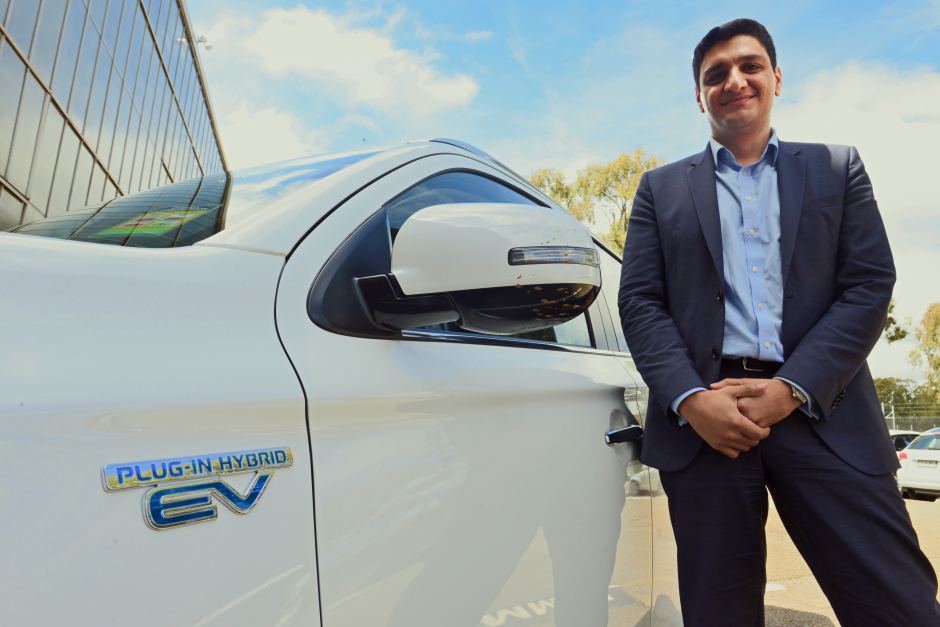
A strong reaction has come from the Electric Vehicle Council to reports South Australian treasurer Rob Lucas wants to introduce road user charges (RUC) for EVs on July 1 next year.
If the measures announced by Lucas go through the SA government will have the “dubious honour” of becoming the only jurisdiction globally to actively disincentivise the purchase of EVs through tax, the council says.
“While governments around the world are using every means possible to incentivise the uptake of EVs, South Australia reckons they have it all wrong,” Electric Vehicle Council chief executive Behyad Jafari says.
“If the revenue from fuel excise is falling because South Australians are burning less foreign oil, that should be considered a blessing,” he says.
“Overall it’s good for air quality, it’s good for the health budget, it’s good for carbon emissions, and it’s great for economic sovereignty.
“The last thing any sane government would do is try to hit the brakes on this trend,” Jafari says.
“It’s like responding to a drop in the tobacco tax take by slamming a new excise on nicotine gum.
“There’s no special bucket of money for roads. Roads need to be paid for from general revenue just like everything else.
“There is zero need for the SA government to slap a big new tax on an emerging technology that delivers so much for the community.”
Lucas is reported as saying he doesn’t think the EV RUC will be a disincentive and that other regions could soon follow SA’s move.
The SA government’s plans were revealed in the state budget on November 10, although the fee has yet to be decided, the RUC’s initial structure comprising a fixed charge plus a distance travelled charge.
SA is forecasting a $2.6b deficit in 2020-21 because of the COVID-19 pandemic and the EV RUC move is designed to replace the loss of fuel excise as internal combustion engine (ICE) vehicle decline – the fuel tax generally used to cover road maintenance costs.
Jafari points out a recent analysis by EY shows every driver who switches to an EV delivers a $1370 boost to government coffers, and an $8763 boost to the Australian economy.
“Treasurer Rob Lucas has described his move as a ‘no-brainer’ – remarkable then that no other jurisdiction on the planet has come to his conclusion,” Jafari says.
“Unless every government in the world is missing something obvious that Mr Lucas uniquely understands, the treasurer may want to re-examine the logic that brought him to this point.
“South Australia can’t hit their net zero targets with this kind of policy approach. The state is currently at less than 1% EV uptake and now they want to introduce the world’s first EV tax,” Jafari says.
“There’s little point spending $18 million on charging infrastructure if you are actively discouraging people from buying the vehicles that can use it.”
In New Zealand, light EVs are exempt from RUC until December 30, 2021, while heavy EVs are exempt until December 31, 2025.

