
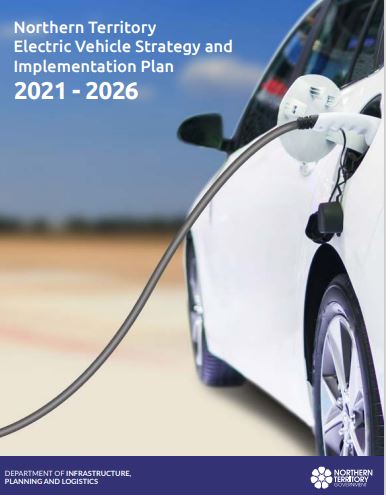
Reduced registration and stamp duty fees from mid-2022, facilitating more EV charging stations, supporting EV technology innovation locally and developing related skills are among key facets of the Northern Territory (NT) Government’s newly released EV strategy for the next five years.
It’s developing a grant program for home, workplace and public EV chargers – with further announcements to be made when the grants are open for applications – and also increasing EV numbers in the NT Government fleet.
NT developed an EV strategy and implementation plan to address climate risk and create new economic and business opportunities following community support for its EV discussion paper in 2019.
Focusing on battery electric vehicles (BEVs) and plug-in hybrid electric vehicles (PHEVs), the strategy and implementation plan will support EV uptake in the NT, its government says.
“The strategy also focuses on passenger and light commercial vehicles, as these are most likely to be the areas with the greatest growth in the near future.
”With renewable energy and electric vehicles, households can reduce vehicle running costs, delivering benefits for Territorians and Territory businesses.”
The EV strategy’s release is welcomed by Federal Chamber of Automotive Industries (FCAI) chief executive Tony Weber.
“Our initial view is that the Northern Territory’s package is a very simple and pragmatic way to promote the expansion of EVs across the territory,” he says,
“We commend the (NT) Government for this and look forward to working with them to expand plans to enhance the uptake of low emission vehicles into the future.”
The FCAI is pleased that many elements of the strategy, including a reduction in stamp duty, align with long-held views of automotive manufacturers.
“For some time the industry has been highlighting just how inefficient stamp duty and other taxes are,” Weber says.
“We are pleased to see this as a potential first step in the Northern Territory adopting a broad-based road user charge (RUC) scheme which could eliminate a myriad of inefficient taxes.”
Weber says the inclusion of an expansion in EV infrastructure within the proposed strategy will be critical in increasing EV uptake.
“To see the Northern Territory Government including grants for EV infrastructure development as part of this strategy demonstrates a mature and long-term approach to increasing the number of electric vehicles on Australia’s roads.”
Weber says the FCAI looks forward to more jurisdictions developing nationally consistent EV strategies across Australia to the benefit of Australian motorists.
The FCAI has recently acknowledged the Grattan Institute’s Towards Net Zero report, and generally supports EV action by state governments such as New South Wales, Victoria, Tasmania and others along with some political party moves.

