This story first appeared in the January issue of EVtalk – CLICK HERE to download the magazine FREE
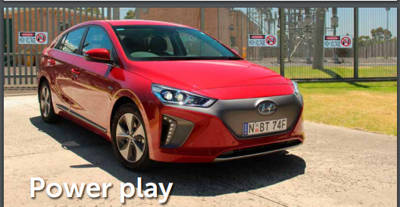 Trying to decide whether to take photos of the Ioniq Electric in the morning sunrise or the evening’s sunset was difficult; time permitting.
It was uncertain whether the dawn would better symbolise that of a new era in the automotive world, or if the setting of Sol was a metaphor that spoke louder for internal combustion’s days ahead.
Hyundai chose the “Ioniq” portmanteau because it combines two ideas: It’s the first vehicle product to offer three variations on the weaning-from-oil theme – unique – and doing it by using molecules with a net electric charge due to the loss or gain of one or more electrons – ion.
Loaned the Ioniq Electric for three weeks over the Christmas break, we racked up well over 1000km courtesy of Hyundai Australia.
We discovered this is the first vehicle, probably in all human history making cars, which is actually nicer to drive in “Eco” mode than its more sportified configurations.
What else makes Ioniq unique is its paradoxically unremarkable qualities.
See, until Ioniq, electric cars have always come with idiosyncrasies inherited since man’s earliest attempts to quantify all-electric mobility.
Driving the first-gen Leaf was like playing Xbox in a bronze-age lounge room compared to regular cars, while the original Prius was so politically “green” just looking at it was like enacting Lady Macbeth’s “Out, damn spot!” sleepwalking scene, trying to cleanse one’s hands of an imagined stain.
Then Tesla came along, like the USS Enterprise during the industrial revolution.
Not once did we experience a hyperventilating, dying need to find a charging station with Ioniq, although three are within a few kilometres.
A day trip to Geelong from Melbourne’s east was easy, with invaluable tech help from Jet Charge.
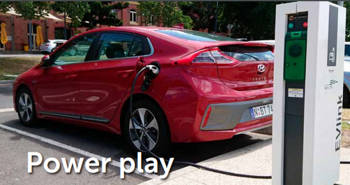
They lent a Type 1 (“J772”)/Type 2 (“Mennekes”) adapter cable which would normally be a $495 extra accessory bought at the Hyundai dealer (or $329 from EVolution).
 There was nothing to worry about even if we hadn’t topped up on the foreshore.
That’s right, vacant parking spaces were available over the busy holidays while juicing up for free.
Both cables can become quite bulky in the 455-litre (to the roof) boot space.
The electric Kona’s boot with 334 litres will be robbed even more with both cables when it arrives.
There was the faintest whiff of range anxiety below 70km, but that irrationality is quickly gone when you realise you’re only making a 10, 20 or 30km round trip with plenty to spare.
In some ways it feels like you’re always running on a third of a tank of petrol – the difference being that you’re not burning fuel to carry the additional fuel in Ioniq.
It also becomes fun trying to mooch off the regenerative braking – we managed an entire trip to visit friends up in the Dandenongs for free and used net zero range.
Damn right.
Even in Eco mode, a 2018 Ioniq strides effortlessly away from a decade-old G6E Turbo Falcon, much to their bewilderment, which makes you realise how far not only Hyundai has come in 10 years, but technology; making a mockery of the J-curve of change.
Progression does have its limitations, which played out courtesy of having to run the microwave, boil a full kettle and pump electrons through the outdoor 10amp point into the Ioniq on one circuit.
This kept tripping our fuse box, mostly because even after the first few times, trying to prep bottles for the four-month-old, you still forget there’s a car refuelling outside the kitchen window.
Oh, yeah.
More normalities come when we look at the price.
First glance says it’s steep for a car with “only” 240km range”, but compare it to the BMW i3s which leaves you little change from $70k and just 200km.
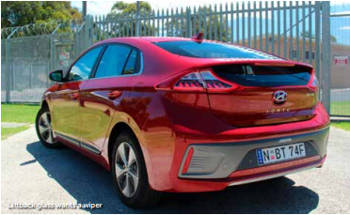
The Ioniq has a centre console that holds more than a banana, the liftback boot fits a pram and its various stupid, accessories, and Ioniq’s backseat can comfortably install a bulky child seat without robbing the front passenger of precious legroom.
Internal combustion feels so gruff and undignified after spending every possible driving moment with an EV like the Ioniq.
The family’s MY18 four-pot petrol-engined wagon, the most refined it’s been in four generations, feels rattly, squeaky, rumbly and rowdy by comparison.
Ticking and thumping is replaced by a sound-effect similar to the Batman bike in The Dark Knight; a series of electrical whines that sound like they’re constantly building, but never reaching.
The old three-point turn has never, ever been easier than the push of two buttons and the wax-on-wax-off motion with the tiller.
Velocity-wise, with a 10-second 0-100km/h you won’t be posting videos on YouTube of Ioniqs embarrassing Lamborghinis and Bugatties on old airstrips, but with 88kW and instantly available 295Nm (in a sub-1500kg package) you will enjoy pulling away down the freeway on-ramp quicker than most bikes, Beemers and bogans-in-Falcodores will ever be expecting.
That said, the 205/55R16 Michellin Energy XM tyres are far from the grippiest boots you’ll ever brush an apex with – in fact you’ll easily hear them squeal in sport, normal and they’ll even give the tiniest hint of scutter in Eco before the traction control puts a stop to that.
A smooth right foot will offer a zippy getaway without waking the electronic constabulary and you’ll leave that V8 Mustang dazed.
That said, the tyres are a very smooth, comfortable package with the well-sorted suspension that never feels overwhelmed.
It’s worth pointing out that the air-conditioning handled several days above 40 degrees quite well without robbing excessive precious km of range, and for once a manufacturer has correctly specced a car (that isn’t an overpriced luxury model) for Australia with cooled seats.
 It’s easy to warm up without heated seats, but that breezy downdraft feels heavenly on a sweaty backside in a country (and hemisphere) that receives significantly more sunlight during summer than to warrant heated seats.
The Ioniq really impressed with its absurdly easy daily use, including plugging it in with only half a hand’s worth of fingers free to open the filler flap, pull the 10amp cable out of the boot, remove both cable plug and filler caps, and flick the switch.
It literally takes 10 seconds, even with a baby in the other arm.
With so many trips being made, delivering presents, hitting the beach, visiting family, running countless times to the shops, and living as hard and heavy with Ioniq every day, it genuinely did everything asked of it.
Putting over 1000km on a car in three weeks is little to what some people might average when they return to work, but it shows that a vast majority of repetitive, punitive mobility can be done at a fraction of the cost, emissions and time of the archaic oil burner.
Ioniq won’t replace oil overnight, nor will it force carmakers to about-face their boardroom ethics on electric cars like Tesla did.
Hyundai haven’t tried to ram the entire future of hyper-technology down buyers’ throats.
They’ve modestly-designed a simple, clean, reliable, and – most importantly – a relatable electric car for you and I.
What it does is prove, surreptitiously, that nine out of 10 times, through blistering heat or pouring rain, the electric car makes its petrol counterparts redundant.
The photos that time permitted had to be taken in the peak of a scorching hot Friday afternoon before returning the car, making it an even better metaphor for what this little device is really all about – making the mundane, the everyday, and the routinely ordinary possible and affordable with an electric car.
And that is truly unique.Extraordinary, even.