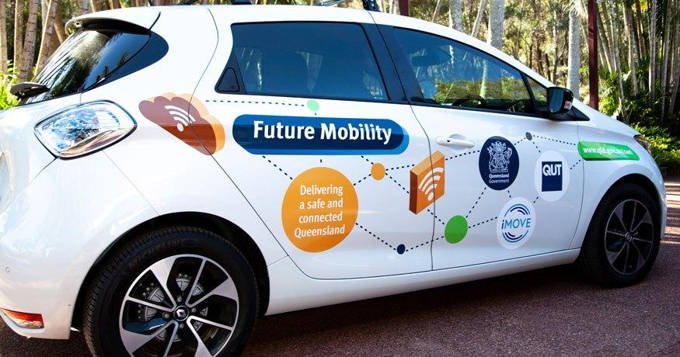
An electric car fitted with high-tech artificial intelligence (AI) sensors and computers will take a three month, 1200km Queensland road trip.
The journey in a zero-emissions Renault Zoe will map Queensland roads for the cars of the future.
“The QUT (Queensland University of Technology) trial, in partnership with the Palaszczuk Government, is the first step in charting Queensland’s vast and varied road network for new vehicle technologies,” transport and main roads minister Mark Bailey says.
“As researchers drive the car across Queensland, onboard sensors will build a virtual map to help refine AI-equipped vehicles to drive safely on our roads.
“It’s early days yet, but AI technology and smart road infrastructure have potential to transform the way we travel in Queensland and reduce road trauma,” Bailey says.
“This is world-leading transport technology research and it’s happening right here in Queensland.”
The road trip is part of the Palaszczuk Government’s Cooperative and Highly Automated Driving (CHAD) Pilot and is supported by the iMOVE Cooperative Research Centre (iMOVE CRC).
Professor Michael Milford QUT’s Australian Centre for Robotic Vision says the challenge for the current generation of automated vehicles is driving as well as people.
“Engineers at QUT’s Research Engineering Facility have developed a research car platform equipped with a range of state-of-the-art camera and Lidar sensors used on automated vehicles,” Milford says.
“As we drive, AI will watch and determine if it could perform the same as a human driver in all conditions.”
Milford says early testing of the system had already revealed how a paint spill on the road could confuse a self-driving AI system into wrongly identifying it as a lane marking.
“Past studies, along with initial experiments conducted by QUT, show how automated cars have difficulties on rural roads which can lack lane markings,” he says.
“A motorist on a rural road knows to stick on the left or imagine there is a line in the middle of the road.
“People will also cross the imaginary line to go around obstacles, it’s quite difficult for an automated vehicle to do this.
“The primary goal of this work is to consider how current advances in robotic vision and machine learning – the backbone of AI – enable the research car platform to see and make sense of everyday road signage and markings that we, as humans, take for granted.”
The research project will study how the automated vehicle’s AI system adapts to Australian road conditions in four main areas – lane markings, traffic lights, street signs and overcoming GPS limitations in built-up areas and tunnels.
Visit www.qld.gov.au/cavi for more information.