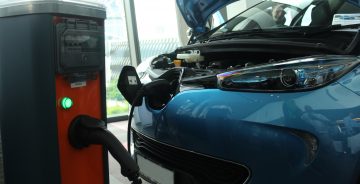
This story first appeared in the November issue of EVtalk – CLICK HERE to download the magazine FREE
Electric vehicle charging station developer E-Station says the young buyers most interested in EVs can’t afford them.
E-Station managing director Patrick Finnegan has told the Australian Electric Vehicle Association (AEVA) Expo in Brisbane that obstacles still have to be overcome.
“All vehicle manufacturers have put their design teams onto EVs and the $30,000 EV will be the tipping point for sales and it will probably come from China,” Finnegan says.
“But the 25-year-old target market for EVs looks at something like the Renault Zoe EV and they simply cannot even get finance for such a car.”

Patrick Finnegan.
Nissan, Hyundai and Renault were at the AEVA Expo with the Leaf, e-Kona and Zoe models respectively.
Expo delegates were unable to learn more about the new Nissan Leaf and e-Kona pricing, however, leaked pricing of the Hyundai Ioniq EV suggests a price tag around $45,000.
“Talking about the cost of ownership is irrelevant until young buyers can get approved on the finance for an EV,” Finnegan says.
The company says it, like several others, is putting an EV infrastructure network into action.
However, Finnegan says EV buyers shouldn’t expect widespread charging facilities at service stations.
“People want to pay the least to charge their vehicles, and it will be increasingly difficult for petrol stations to compete with the low cost of charging at home.
“This is why service stations have been reluctant to offer charging stations because people won’t pay that premium if they have sufficient range to bypass and charge when they reach their destination.
“That’s where destination charging will be the next cheapest form of charging – at the place you ultimately intend to visit.
Nonetheless, it will still be very hard for charging networks to compete with recharging at home.”
Queensland University of Technology’s Jeremy Webb and Queensland University’s Jake Whitehead revealed an EV owners survey showing 46km is the average daily distance travelled, and that 93% of owners recharge their EVs at home.
Only 3% recharged at work – highlighting a lack of workplace charging infrastructure – and only 1% used DC fast-charging stations from any of the variety of networks such as Chargefox, ChargePoint, Tesla superchargers and Tritium stations.
Finnegan says it would be pointless putting a charging station at a service station between inner Sydney and Katoomba, for instance, because most EVs can make that distance without having to stop and pay for DC fast-charging.
“There will not be as many motorway fast-charging booths as people may have been expecting.”
He sees demand increasing in the EV industry for skilled tradespeople.
And on home solar charging to supply EVs, Finnegan says: “I have architects calling and asking for advice on how they go about designing homes with solar-powered charging for two Teslas.