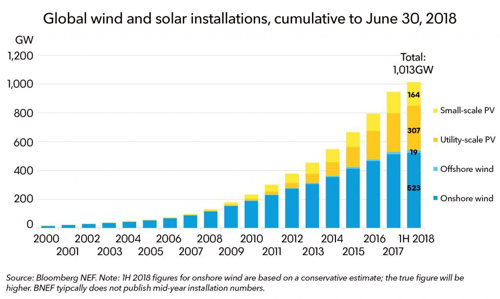
Humans have produced the first teraWatt of renewable electricity through solar and wind energy infrastructure.
A second teraWatt will be made as soon as 2023, and cost nearly half – 46% less in fact – than the first, according to Bloomberg NEF data, which is predicted to boost electric vehicle uptake.
The NEF also expects the cost of electric vehicles to become cost-competitive without subsidies in 2024, with electrification to remove 7.3 million barrels of fuel in 2040 when a third of global fleet sales will be EVs.

BNEF’s New Energy Outlook 2018 lead author, Seb Henbest. Image- BNEF
“Once derided as toys, electric vehicle sales are on pace to reach over 1.6 million this year, up from just a few hundred thousand in 2014,” says Colin McKerracher, BNEF head of advanced transport.
The New Energy Finance report says humans achieved the first renewable teraWatt (1,000 gigaWatts) capacity before June 30, with 54% from wind and 46% solar.
Total installed capacity has grown 65-fold since 2000 and quadrupled since the start of this decade. Photovoltaic (small scale) solar alone has grown 57-fold since 2007’s mere eight gigaWatts.
The first TW is estimated to have cost $2.3 trillion dollars of capital expenditure – the second TW should cost around $1.23 trillion from now to 2022.
Including hydro-generated renewable energy, that 1TW doubles, having been attained in 2010.

Colin McKerracher, BNEF. Image- BNEF.
“Wind and solar are set to surge to almost “50 by 50” – 50% of world generation by 2050 – on the back of precipitous reductions in cost, and the advent of cheaper batteries that will enable electricity to be stored and discharged to meet shifts in demand and supply,” explains BNEF’s New Energy Outlook 2018 lead author, Seb Henbest.
“Coal shrinks to just 11% of global electricity generation by 2050,” he says.