
This story first appeared in the May issue of AutoTalk – CLICK HERE to download the magazine FREE
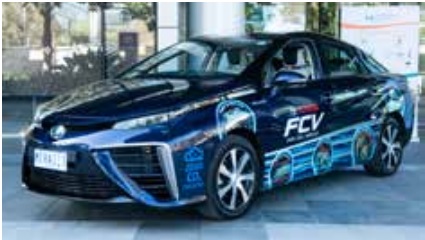
Toyota’s Mirai FCEV
Rather than pick a winner between battery electric vehicles (BEVs) and hydrogen fuel cell electric vehicles (FCEVs), energy expert Stephanie Moroz aims to provide a balanced discussion at an upcoming clean technology conference of how the different technologies complement each other.
Speaking at the 2019 National Clean Technology Conference & Exhibition on the Sunshine Coast from May 29-31, Moroz says it’s a shame our culture seems obsessed with having a single winner because one solution would deplete resources for it far quicker than applying a mix of technical solutions.
“Every technology that is widely implemented will have a major impact on the environment through its consumption of natural resources, and so the most important solution of all has been woefully neglected, namely energy efficiency,” says Moroz, who is principal at Davanz, advising on strategy, innovation and commercialisation of energy technologies.
Moroz was named one of Australia’s “Most Innovative Engineers” in 2016, and she has more than 20 years of product development experience in companies ranging from high volume manufacturing to venture capital backed start-ups.
With particular expertise in hydrogen, internal combustion engines (ICE) and batteries, her automotive work has included leading the fuel cell integration into the Mercedes F-Cell vehicle in Germany and developing engine systems using petrol, diesel, biofuels and synthetic fuels in France.

Stephanie Moroz
Prior to Davanz, Moroz was chief executive officer at Nano-Nouvelle, developing high performance lithium-ion battery materials.
Asked how Moroz sees hydrogen fitting into the low/zero emissions equation – such as suiting longer range transport like trucks, ships and trains, Moroz says hydrogen is receiving more support for longer range transportation because, for larger systems, increasing the hydrogen storage is less expensive and requires less weight and volume than an equivalent increase in range using battery storage.
“As battery prices come down and as hydrogen system costs come down, I would expect to see increasing overlap in the applications,” she says.
“There are many aspects to consider in choosing a technology, for example, the fuel cost and availability, so that regional economic factors may favour either electricity or hydrogen.”
At least one power company involved in renewable energy sees little point in producing hydrogen because it uses three times the amount of electricity to make it (electrolysis).
So, what does Moroz think?
“If the hydrogen is produced at the same location with the same electricity that would otherwise recharge a lithium ion battery, a much larger amount of electricity will be necessary to produce the hydrogen that powers the car an equal distance,” she says.
“However, there are usually many factors at play in any given situation, for example, often there is no requirement that the hydrogen would come from the same electricity source, for example it could be produced in bulk somewhere else where electricity is cheaper.
“The electrolyser producing the hydrogen may also have benefits to grid stability beyond what a battery system is capable of providing and thereby offset the cost of the hydrogen provided to vehicles.
“ Nevertheless, there is a real need to develop more renewable sources of hydrogen and researchers are working on other ways to split water such as solar thermal, photocatalysis, biological systems, fermentation, and biomass or waste conversion.”
Moroz says batteries have had much more research and development money invested in them over the past 20 years than hydrogen technologies.
“So, there is still a lot of opportunity for hydrogen to make progress.”
Asked about the costs of hydrogen infrastructure such as storage, transport and vehicle refuelling, Moroz says hydrogen infrastructure is far more developed than Australia in other parts of the world.
“Typically, it begins at local refuelling hubs to service fleet vehicles that always return to the same place to refuel,” she says.
“Jumping to a broad network is a bigger challenge though because a refuelling station is not profitable if there aren’t enough cars, and people won’t buy hydrogen cars if they don’t have enough options to refuel them.
“This is where typically a consortium of industry players agree to work together to build out an infrastructure rapidly, as is the case in parts of Europe and Asia.
“Existing service stations can often be used, but their suitability depends on the local regulations around compressed flammable gases and whether they have the space available for another fuel supply.”
Moroz was also asked where and when she sees hydrogen becoming a viable fuel, particularly with fuel cell electric vehicles (FCEVs) like Toyota’s Mirai and the Hyundai Nexo available.
“It depends entirely on decisions that will be made by industry and government regarding investment, incentives and taxation,” she says.
“The technology exists, and with investment the costs can come down, so it depends on policy decisions.”
Moroz adds that the BEV market has taken off overseas and a good range of models are starting to arrive in Australia
“Meanwhile, hydrogen fuel cells for automobiles have had their ups and downs over the years, but they appear to be finally gaining some initial traction in overseas markets, which has drawn the attention of various Australian industry and government bodies.
“The debate is now raging; which electric vehicle is better, batteries or hydrogen? Is the internal combustion engine dead, or can we find alternative fuels for it? Which technology will ‘win’ this race?”
Those at the clean technology conference will learn more and, if as Moroz says, there is more than just one winner.
The event will have about 250 delegates, 40 exhibitors and 55 speakers, along with study tours, workshops and two full days of conference sessions.

