This story first appeared in the April issue of AutoTalk – CLICK HERE to download the magazine FREE

Christina Bu
Confused with the acronyms and all the claims to be “electrified” surrounding electric vehicles? You are not alone.
So, to clarify matters once and for all, the term EV applies only to electric vehicles which don’t give off emissions and pollute the atmosphere.
Gone is the term BEVs (battery electric vehicles) for the simpler EV.
Gone too are PHEVs (plug-in hybrid electric vehicles) and hybrids, which are somewhat better than internal combustion engines but definitely give off emissions and pollutants.
They can no longer be called EVs.
All this was decided at a meeting of European EV owners’ associations – and others from the USA and around the globe – prior to the recent Nordic EV summit in Oslo, Norway.
“The buying public are confused with all the terms bandied about by those selling EVs.
 If they’re not pure EVs they should not be using the confusing term ‘electrified’ vehicles,” says Christina Bu, who heads up the 70,000-member Norwegian EV Owners’ Association.
Bu also wants to see hybrids and PHEVs off the market as quickly as possible.
“They filled a purpose in helping buyers over ‘range anxiety’ in the early days when chargers were few and far between.
But now there are chargers on every major route in most developed countries, hybrids and PHEVs are only extending the life cycle of internal combustion engined vehicles.”
Bu has the data from registrations in Norway to back up her point.
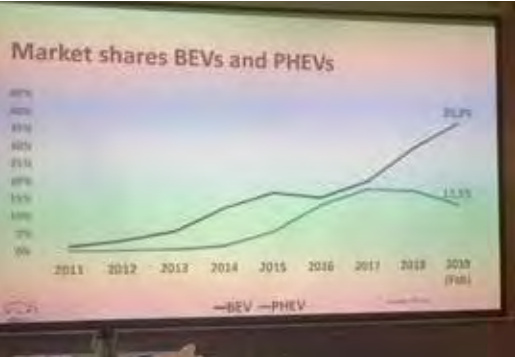
Until 2017, pure EVs and PHEVs sold at a similar pace in Norway, with slightly fewer PHEVs.
But since 2018 the gap between sales of pure electric vehicles and PHEVs has widened to three to one.
For the full 2018 year, 39.3% of all cars sold in Norway were pure EVs, with sales of PHEVs plunging to 13.9%.And in 2019 the gap has widened further.
About 53.2% of all new cars in 2018 were EVs and PHEVs – this year pure EVs will total more than half of all cars sold in the Nordic country.
And the goal is to have every passenger car and light commercial sold in Norway by 2025, 100% pure EV.
Yet in 2010 75% of all light vehicles sold in the country were diesels.
“To achieve this 100% EV goal in only six years, the government taxes what we don’t want – vehicles that pollute – and promotes vehicles than can run on 100% renewable energy,” Bu says.
She adds that the government incentives are in place till at least 2021 – hopefully until the 100% goal is reached in 2025.
There is no purchase tax for EVs in Norway (25% for non-EVs), no annual road tax and charges on toll roads, ferries and parking cannot be more than 50% of the cost levied on petrol or diesel car owners.
Bu says that 92% of EV owners are satisfied or very satisfied with their EV – while 73% of EV owners have inspired one or more in their social circle to also buy an EV.
Some 45% of EV owners charge at public fast chargers rather than at home, with the government of Norway moving to encourage charging via parking spots in residential accommodation without garaging.
Residents living in apartment buildings cannot be denied charging facilities without the landlord having a valid reason.
Bu says the rapid adoption of EVs in Norway is “demand driven” but that this demand is backed by strong government incentives.