This story first appeared in the October issue of EVtalk – CLICK HERE to download the magazine FREE
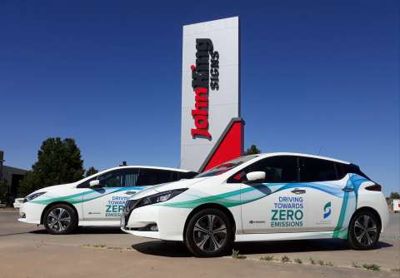
Nissan Australia has broadcast the local reveal of the next-gen Leaf electric car, which will start showing up at dealerships across the country in mid-2019.
Nissan has also pledged to electrify a third of its Australian product range, in either full or hybrid form, by 2022, such as its Juke and Qashqai SUVs by 2019 and 2021 respectively.
X-Trail, Nissan’s best-selling model, could also be due for battery power.
 Speaking to EVtalk, corporate communications manager Tony Mee and head of electrification Wayne Harris say the Leaf is going to be sold and serviced from 89 Nissan showrooms, including 62 in metro and 27 in regional/provincial areas.
“The world’s a different place to what it was in 2012 when the first Leaf came here,” Mee begins.
“There’s more conversation, more interest in the market place by the buyer wanting to purchase an EV.”
He says all capital cities and key provincial areas will be able to buy a Leaf, which the carmaker says will dramatically improve its sales over the old car.
But Mee says stock volumes and expectations to sell remain with the dealerships to gauge and won’t necessarily be determined by anything contractual.
“We’re delighted with the take up from the 89 dealers, we’re basically saying ‘if you want to sell the Leaf, we’ll make it happen’,” he explains.
“While we expect our dealership network to total 89 by the time the Leaf arrives next year, that number could well increase by dealers that raise their hands,” Mee says.
“This is particularly true of rural areas, where Leaf sales are less likely, but then it depends what’s going on because if the infrastructure is there, and the dealer recognises an opportunity for sales, they can put their hand up and sell the Leaf.”
Nissan says the new Leaf’s prospects are to remain “dealer driven”.

“We’re offering all dealers an opportunity to take cars for the business, if they want to sell Leaf they can.”
But when it comes to marketing, Mee says there are plenty of unconfirmed details around how the Leaf will be promoted – an area seldom explored with manufacturers selling EVs Down Under.
“It will absolutely get the support it needs to push it [to customers] across the country,” Mee confirms.
However, when asked Mee stops short of saying the Leaf will get the attention of mainstream models like Navara or X-Trail – despite being referred to as the “halo car for Nissan Intelligent Mobility.
“I don’t think so, they’re core models,” he says.
 “It’s a very important vehicle for us, and we want to give it every chance, but the volume against Qashai for example, isn’t there,” Mee concedes.
“But the marketing team will give it every opportunity to sell.”
“Leaf is still due in dealerships mid-2019 and it’s been in other markets around 12 months, so there’s already a lot of info out there,” he adds.
Asked how eager Nissan Australia was to beat Hyundai’s first-go Ioniq hybrid and EV range, Mee says it wasn’t the company’s focus.
“Not at all, we don’t focus on what our competition is doing,” he says frankly.
“We launch a vehicle at a time that’s right for us – that could be on the same day – but no, we’re not holding out to see what others are doing.
We’re just getting our strategy right so that when we go to market we’re in the best possible place.”
Quizzed on whether publicity from other OEMs will help boost mutual market interest in the Leaf, in the same way Hyundai has said in the recent past it welcomes all the attention competitors like Tesla, BMW, Nissan and Mitsubishi can get in order to get people thinking about buying EVs, Mee says it’s more a case of “right time, right place” for the Leaf 2.
0.
“I don’t think it’s so much competition, as much as there’s more information and interest in EVs now,” Mee says.
“We’re naturally having the conversation, more people are listening.”
He says the market is more mature and there is more appetite for EVs in 2018-19, which as Nissan-backed research by Kantar TNS suggests, 63% of new car intenders are more likely to consider an EV than five years ago.
“We’re not just selling the car anymore, but also the charging hardware with help of JET Charge,” Mee says.
Electric vehicle charging infrastructure distribution and installation business JET Charge has partnered with Nissan Australia to supply hardware to Leaf customers and those 89 dealers.
JET Charge director Tim Washington says Australia’s traditional psychological barrier about charging infrastructure and driving long distances is unjustified.
“Virtually all the charging people are ever going to do with an electric vehicle like the Leaf is going to be at home or work,” he explains.
“So coupled with the fact the majority of people don’t actually drive those huge distances they worry about, it shouldn’t be a realistic concern.
“People doing over 1000km, sure it’s not suitable.
But practically, Australia is not unique, 80-90% of charging will be done at home or work, so once you have that charging facility at home, with such a high number of garages in Australian homes it takes care of itself,” he says.
Washington says dealerships will not only be able to sell Leaf, but they’ll be able to put the cars to good, practicable use in the meantime; an excellent sale pitch to customers, at the very least.
“There is a dealership in Queensland with 89kWh of solar on their roof – that’s a lot – but they’re not allowed to export it into the grid in Queensland,” he explains.
“Their on-roof solar is enough to power the dealership during the day, but they can’t use it to power the place at night.
But with the Leaf, they can store that excess solar energy in the car and use the vehicle to power the dealership at night,” Washington reveals.
“Keeping lights on is a huge expense to dealerships, but this is a game-changer for the dealer; the Leaf is an energy asset,” he says.
“Very soon, it won’t be about buying a car, it will be about buying mobile energy assets,” he adds.
The business already has huge curiosity from business fleets around the country.
“Consumer interest, especially among fleets, is extremely strong,” Washington says.
“For fleets it’s a necessity.
“For public charging it depends on the business – there needs to be some benefit to the business of having EV charging stations on site.”
Washington says plans for the Leaf charger unit pricing are, “not ready for release yet,” and he “can’t say” what kind of discount dealers should receive for the charging hardware.