This story first appeared in the february issue of Evtalk – CLICK HERE to download the magazine FREE

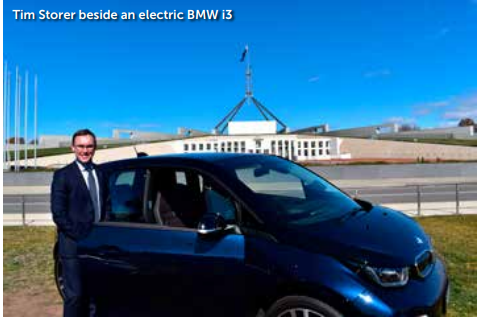
Tim Storer.
A national electric vehicle strategy implemented under an inter-governmental taskforce should be a priority for the Australian Government.
That’s the key recommendation in a report of the Senate Select Committee Inquiry into Electric Vehicles, chaired by Tim Storer, independent senator for South Australia.
It’s now up to the Federal Government to consider this among the committee’s 17 recommendations to accelerate EV uptake in Australia and take advantage of the opportunities the EV transformation presents.
EVangelists are hoping that might happen before or just after the federal elections, widely forecast for May 2019, with the 2019 Budget expected on April 2.
Storer say voters deserve to know before they cast their votes exactly what the parties vying to form the next government plan to do to lift Australia’s EV game.
“Even though we are now in the shadow of an election, the major parties decided not to put their money where their mouths are with regard to specific measures to accelerate uptake.
That is despite their acknowledgement that accelerated take up of EVs would have ‘substantial economic, environmental and health benefits’.”
Electric Vehicles Council of Australia chief executive officer Behyad Jafari says major parties have the opportunity to include the recommendations in their platforms.
As well as leading a national EV strategy, the Australian government should also set national targets for EV uptakes, provide incentives, and develop a comprehensive plan for the rollout of public charging infrastructure, the committee suggests.
The senate committee received 137 submissions and heard from 85 witnesses.
“I am pleased that all members of the committee agreed that Australia lags behind other countries in EV take up because of the ‘relative absence of overarching policy direction from Australian governments’,” Storer says.
The committee also acknowledged that without “appropriate regulatory settings, Australia’s near term EV uptake is likely to be modest” with the result of “fewer EV models being available to Australian motorists” as well as delaying “the realisation of substantial economic, environmental and health benefits”.
 The Luxury Car Tax should also be overhauled, it says.
“The package of measures I proposed would be revenue neutral over the forward estimates,” Storer says.
“Further, I proposed phasing in a Road User Charge for EVs from 2025-26.
“As the contribution of fuel excise to the cost of building and maintaining our roads declines, it is only equitable that owners of EVs make a contribution to our transport infrastructure.”
EVs are projected to achieve price parity with internal combustion engine (ICE) vehicles by the middle of the coming decade.
“So it would be responsible and equitable policy to delay the introduction of a Road User Charge for EVs until 2025-26,” Storer says.
“My package is responsible, evidence-based policy making with clear benefits for the motorist, community health, the environment, the economy and the budget.
Some incentives suggested include exempting EVs from import tariffs and from fringe benefit tax until 2025-2026, mandating 50% of all new Australian Government fleet leases be EVs by 2025-2026, assisting an EV manufacturing grants scheme and providing EV research and development grants.
One unusual request from the select committee is for governments to seek a round of the Formula E electric racing series in Australia, with South Australia’s government reported to be interested in bringing electric racing to Adelaide’s street course.
Meanwhile, most Australians want the state and federal governments to implement policies that would encourage more EVs on Australian roads, new research from The Australia Institute Climate & Energy Program shows.
Its key findings reveal an overwhelming majority of Australians (79%) support the Government building a network of EV charging stations across the country, that the majority of Australians support for governments to procure EV fleets (76%) and support providing loans for EV uptake (55%).
Almost three out of four Australians (74%) support rebates to promote installation of EV charging stations and for new apartment blocks to be required to host them (73%).
Two out of three Australians (66%) want the Luxury Car Tax removed from imported EVs.
 “Our research makes it clear that Australians are keen for the Government to encourage electric vehicle uptake through a range of policy measures,” the Australia Institute climate and energy program director Richie Merzian says.
“Australia has a high-polluting transport sector, transport emissions have increased 59% since 1990 and continue to climb.
There are numerous, popular policies available to the Government to help drive this around, including changing their fleet to electric vehicles.
“Removing barriers to electric vehicle ownership, such as the Luxury Car Tax and providing concessional loans can drive serious growth in electric vehicle uptake.
“If we look at Norway as an example, where electric and hybrid cars now make up half of all new car registrations – compared to Australia where EVs don’t come close to even 1% of new sales.
“State and territory governments have taken steps in the right direction but there has been a real absence of federal policy leadership.
“For the Senate Inquiry into Electric Vehicles to recommend the most popular of these policy initiatives is a step in the right direction.
“It is clear that helping Australia transition to electric vehicles is good for the economy, good for jobs and good for the environment, but our research shows it would also be good at the ballot box come election time.”
In New Zealand, EV incentives are being considered with the country already having EV targets and a temporary exemption from Road User Charges.
Visit https://www.aph.gov.au/Parliamentary_Business/Committees/Senate/Electric_Vehicles/ElectricVehicles/Report for more information.